It all started with a question.
“Can my friend Ray play?”
Five words. That's all it took to open a door I never knew existed.
By then, music had already become an important part of my life. I'd written compositions, conducted my high-school orchestra, and started earning money at the piano. But I had no idea that one casual question in a downtown Fort Worth restaurant would lead to thousands of performances, tours entertaining American troops overseas, encounters with presidents, and a decades-long adventure with Four Day Weekend.
Looking back, the strange thing isn't how much of it happened. It's how much of it was improvised.
The soccer player who found a piano
When I was a kid, music wasn't the grand career plan. I wanted to play professional soccer. Then I suffered a terrible knee injury, and that dream was over. My mother encouraged me to take piano lessons. I can't say I immediately fell in love with the lessons themselves.
I hated the endless technique and the feeling of being compared to other students. But the last five minutes of each lesson were magical. My teacher would let me make something up. Improvise. Just play. Suddenly there wasn't a right way or somebody else's music to reproduce. There was only whatever I could hear in my head.
I lasted about six months in lessons before quitting. The piano, however, wasn't going anywhere. I kept playing on my own. I'd learn harmony and chord changes by ear, experimenting until they made sense. I didn't have formal theory training until college. My attitude was, and still is, I learn by doing!
Around twelve or thirteen I wrote one of my earliest serious pieces, “Mommy, Please Don't Leave,” inspired by the pain of my parents' divorce. It's a revealing title for a kid's composition, isn't it? Even then, music was where I could put feelings I couldn't quite explain.
Before long I had written dozens of piano pieces, from contemporary little melodies to my attempts at serious classical music. I also played trumpet. At the time I didn't know that every one of these experiences would eventually matter.
The band hall after everybody went home
My high-school band director was a man I call Mr. G. At seventeen, he asked me what I planned to do with my life. I wasn't sure. He told me, “You should consider music. You have the look and the talent.”
That one conversation changed the way I thought about my future. I started auditioning for piano jobs, including Crystal's Pizza and a church. What had been the thing I loved doing was beginning to become the thing I actually did.
High school itself was not a typical experience for me. My parents had divorced and remarried, and both had moved away. I wanted to stay and finish school where I was. A family friend was given power of attorney so I could do that. In many ways, I was learning to be independent before most kids my age.
The band hall became my refuge. I practiced trumpet and piano there after school, sometimes staying until the janitors were ready to lock up. I also discovered the grand piano in the auditorium. I wasn't exactly supposed to be in there, but I would sneak in and play for hours. The janitors knew. They seemed to enjoy listening, and they let me stay.
I can still picture that empty auditorium. Nobody in the seats. Just a teenager, a grand piano, and endless possibilities. Mr. G gave me more than lessons in music; he gave me permission to imagine a life in it.
My first work for wind ensemble, and my father's close call
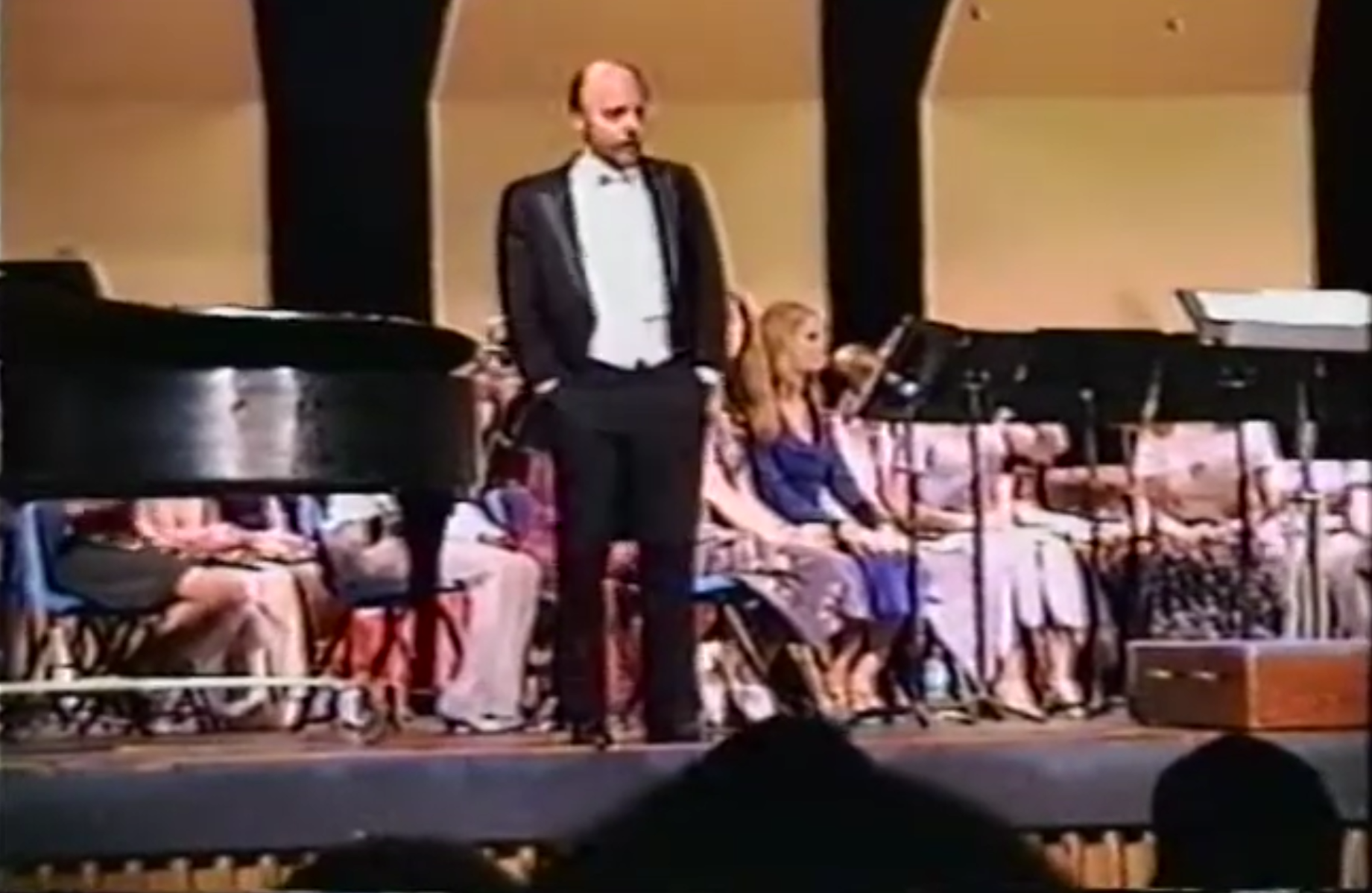
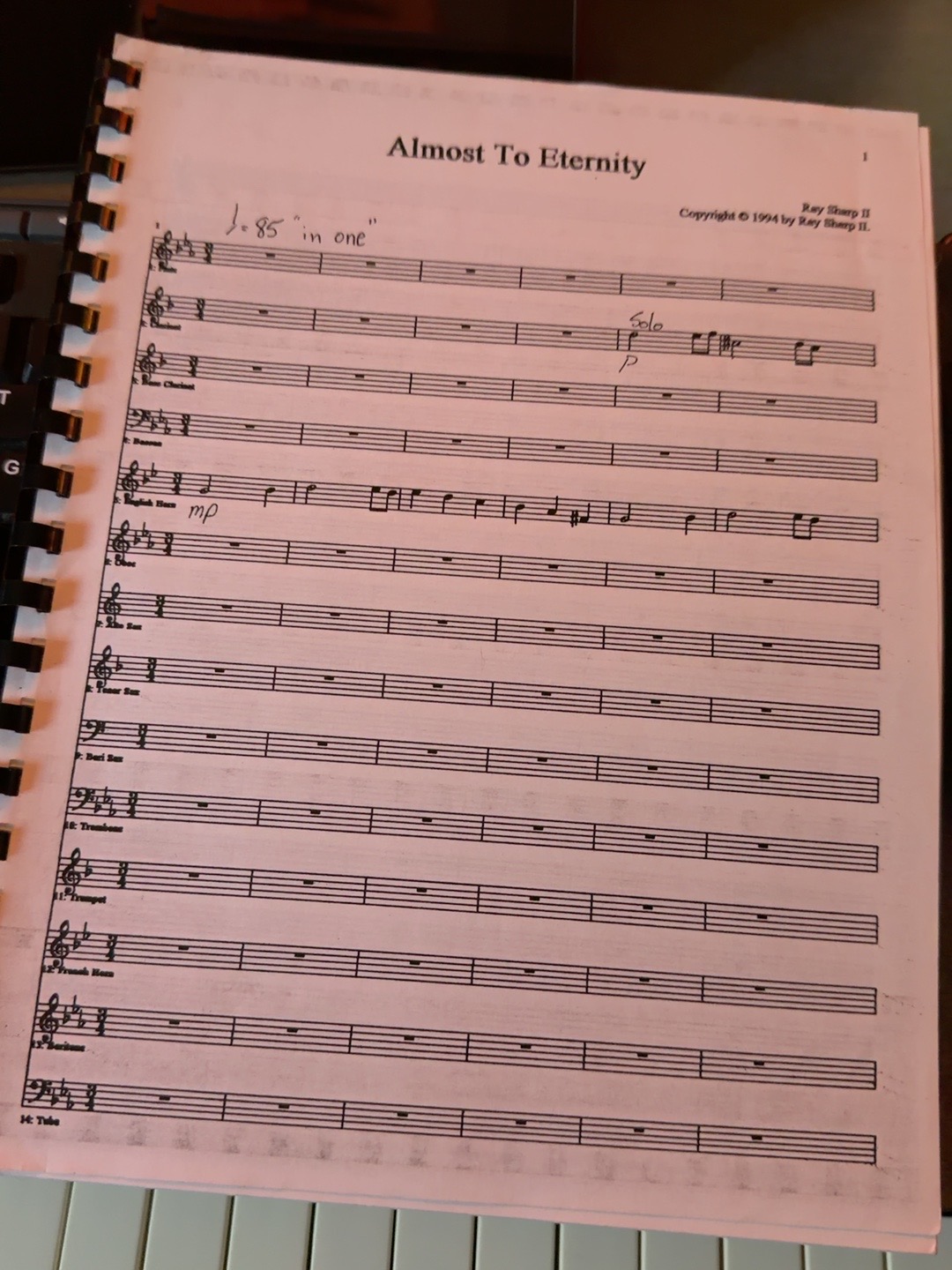
In 1994, I wrote my first wind-symphony piece, Almost to Eternity. The title wasn't a poetic flourish pulled out of thin air. My father had nearly died because of a mistake during gallbladder surgery. He survived, thank goodness, but that terrifying experience became the emotional source of the piece.
I wrote the music in Cakewalk, entering and playing every part myself. Then came the astonishing part: Mr. G agreed to have the school musicians perform it—and to let me conduct.
I still remember him coming down the hallway with stacks and stacks of printed instrumental parts, papers almost spilling out of his arms. It was such an extraordinary act of faith in a kid who'd been writing music on a computer. He didn't just pat me on the back and tell me to keep practicing. He helped put my music into real musicians' hands.
When Mr. G introduced me to the audience, he called me his “musician, colleague, and friend.” I was still a teenager. He was my teacher, my band director, somebody I admired enormously. And there he was, introducing me not merely as a student, but as a colleague and a friend. I don't think he could have known how much those words meant to me.
Years later, after he passed away, I wrote to his daughter to tell her what he'd meant to my life. Looking back, I realize he hadn't simply encouraged me to pursue music. He'd treated me like a musician before I fully believed I was one.
And then I stood in front of the ensemble and conducted something I'd written. Hearing those sounds in the air, played by people rather than a computer, was surreal and magical. I love, love, love that memory.
Years later I've conducted and recorded my music with professional orchestral players, but a piece of that first feeling will always belong to Mr. G and that high-school band hall.
A French horn for Kristin
The following year brought a very different piece. Kristin Noel Klemick, a fellow French-horn player, was eighteen when she passed away after a severe asthma attack triggered by sulfur in the air at a Fourth of July fireworks event. The loss was devastating. I wanted to do something with the grief, and once again the only language I really knew was music.
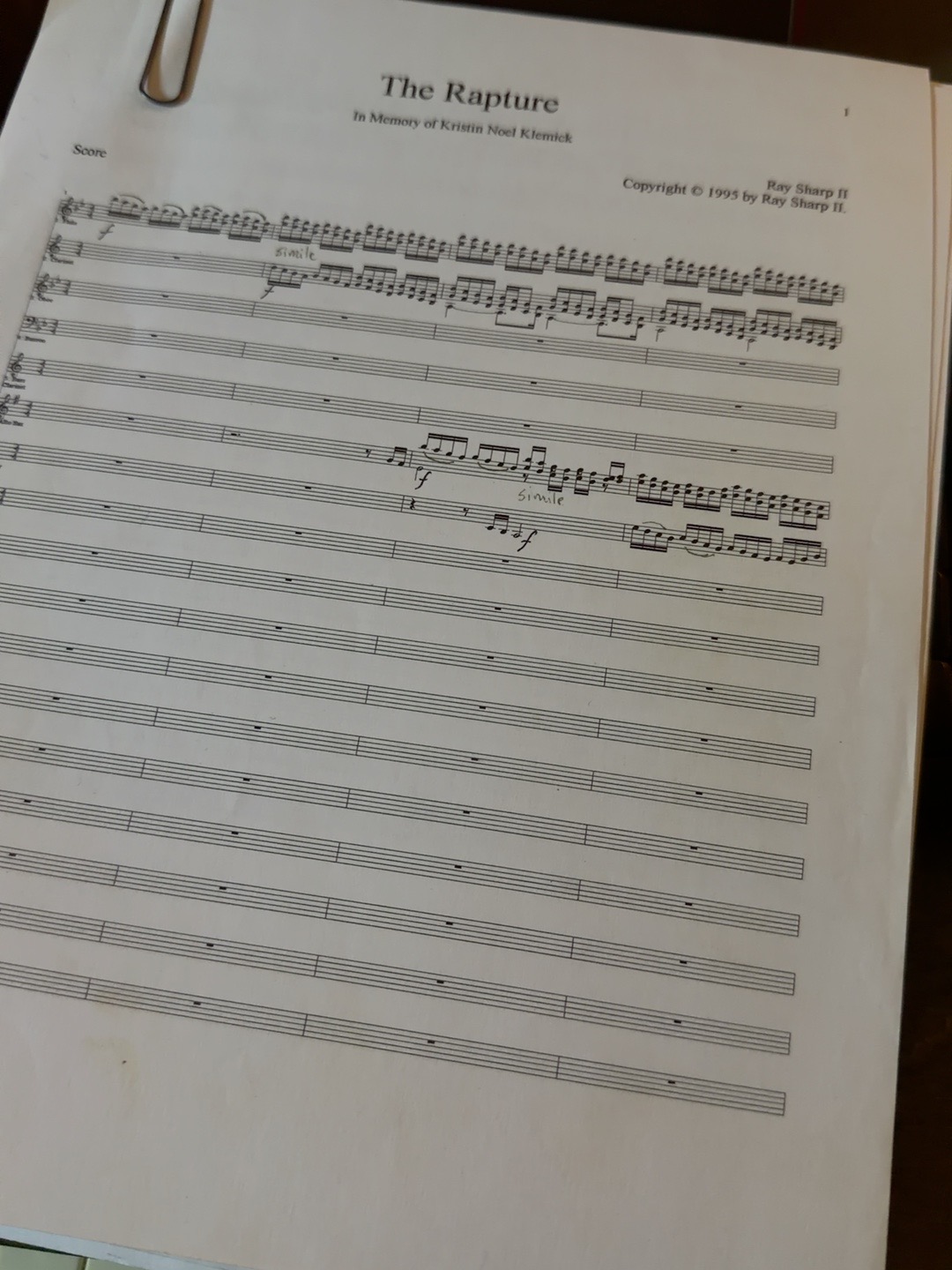
In 1995 I composed The Rapture and dedicated the score “In Memory of Kristin Noel Klemick.” Mr. G supported me again, and I got to conduct another of my own works. This one ended with a French-horn solo, a musical goodbye to someone who had played that instrument herself.
When that final French-horn note faded, the audience rose in a standing ovation. Everyone was in tears. I walked over to Kristin's parents while the applause continued. It was one of those moments when you realize the music has said something that words simply couldn't.
I gave the score to Kristin's parents. They kept it on their mantel. Of all the places my music has ended up, that one means something entirely different.
Both of those original scores still exist. When I found them again decades later, I could look at the notes and see a teenager trying to understand love, fear, grief, and survival through an orchestra. I didn't have all the answers then. I still don't. But I knew music could carry the questions.
“Can my friend Ray play?”
My first professional piano work included Crystal's Pizza, where I started playing while still in high school, and the church where I'd go on to play for decades. I learned to keep a room company with nothing but a piano. Later came the Sundance Market & Deli in downtown Fort Worth, and Saviano's near the airport.
The Sundance job happened almost by accident. One evening, some friends from Hurst and I went to a movie, then wandered into downtown Fort Worth. We ended up at the deli, where there happened to be a piano. My friend Chad asked the manager, “Can my friend Ray play?”
The manager said yes. I sat down, played, and she offered me a job right there.
Five words at a deli piano. A completely different life on the other side.
On Friday nights I played at Sundance, and one of my listeners turned out to be the wife of Troy, a founding member of Four Day Weekend. The group needed a pianist. She told them about me. I was invited to be a guest musician, and after roughly six months I became their musical director.
Since 1999, Four Day Weekend has been a huge part of my life. I've played more than 9,000 shows, helped score countless moments that only existed for a few seconds, toured overseas to entertain American troops, and met presidents George W. Bush, Barack Obama, and Joe Biden. David Ahearn even wrote an entire book about one of the troupe's extraordinary stories—We'll Always Have Paris. But the part I treasure most isn't the résumé. It's the trust.
Good luck, kid.
We were doing a show for some very important military folks when someone whispered through the curtain, “Hey Ray, we're going to do the national anthem next.”
Not Do you know it? Just: We're doing it. Good luck, kid!
Josh Roberts was going to sing. We hadn't rehearsed it, of course. Josh ran over in a panic. “I guess we're doing this. What key?” I told him C was the only key I knew it in—and it had been years since I'd played it.
I used my ears. I reached back to the memory of playing that famous melody on my trumpet when I was younger. I tried to anticipate every breath and every turn Josh would take. We were both flying by the seat of our pants.
We nailed it, and the room erupted. Whew. That was a close one.
That's what being in an improv ensemble means. You're stepping into the unknown with people who have to trust one another in ways I can't really put into words.
The Phantom, duct tape, and 2,500 people
For Four Day Weekend's twentieth anniversary, we decided to perform at Bass Performance Hall in Fort Worth. We sold it out—about 2,500 seats. That is a lot of people to stand in front of when you have no idea exactly what's going to happen.
Maybe thirty to forty-five minutes before showtime, Josh Roberts came up with an idea for a bit. Josh is a fantastic singer and loves The Phantom of the Opera. In the first act, he'd interrupt our show and ask Ahearn to let him perform a song from Phantom. After all, we were in Bass Hall! Ahearn would refuse, telling him it was a night for the whole ensemble to shine—not a solo showcase for Josh.
Josh stopped the show three or four times, and Ahearn said no each time. The audience thought they were watching a running gag. We were setting a trap.
We got to intermission. We still hadn't rehearsed anything. The hall had the Phantom chandelier, and our idea was to use it: the second-act curtain would lift, the chandelier would fall, and I would hammer out that famous organ riff on the piano, fortississimo. I'd played it years earlier—but not recently, and certainly not after practicing for this moment.
Right before walking onstage, I scribbled down the chords for our bass player and other keyboard player. “Follow Josh!” I told them. To the drummer: “Use a suspended cymbal and follow the crescendos.” They were nervous. I was nervous. Everybody knew just enough to be terrified.
The curtain came up. The chandelier dropped. I blasted the riff with everything I had. And there was Ahearn—duct-taped to a chair. Huge laugh.
Josh entered in full Phantom costume. I transitioned into “The Music of the Night.” He sang it beautifully—except he had replaced those gorgeous lyrics with a song about farts. A ridiculous, magnificent piece of theatrical nonsense. He got an immediate standing ovation.
It was glorious and ridiculous. And nobody had rehearsed it.
We followed it with a Hatfield-and-McCoy bit and, yes, eventually released Ahearn. You have to be a little crazy to attempt something like that in front of 2,500 people. Thankfully, the rest of the troupe was exactly that kind of crazy.
When the microphones died
Four Day Weekend was scheduled to introduce Santa at the end of the Fort Worth Christmas parade. We'd written a parody called “The Twelve Days of Fort Worth,” a local spin on “The Twelve Days of Christmas,” and were ready to perform for a crowd of around 40,000.
We walked out onstage, and not one microphone was working. The guys were standing there with nothing to sing into. Forty thousand people were staring at us, waiting. My keyboard, bizarrely, was the one thing that still worked.
I started playing “Joy to the World.” And then something I was completely unprepared for happened: forty thousand people began singing along. I wasn't leading an ensemble of comedians anymore. I was accompanying an entire city.
It ended beautifully. The microphones were still dead. What now? Well, how about “Silent Night”?
Again, that enormous crowd sang with me. The sound of all those voices is something I will never forget. I get chills just thinking about it. Though in the moment, my internal monologue was considerably less poetic:
Don't fuck this up! Remember the chords!!!
Sometimes the equipment fails, the plan disintegrates, and the moment becomes better than anything you could have scripted.
A tiny keyboard and a sweater for a suitcase
On a tour entertaining American troops overseas, the airline lost my musical equipment on the way to Kosovo. All of it. This is a particularly exciting development when you're the musical director of a comedy troupe and your whole job depends on making sound.
Thank goodness I'd carried my iPad onboard. It held the tracks and sound effects for the show. At least those hadn't vanished into airline purgatory.
Someone sent an email to all the troops stationed there asking whether anybody had a keyboard. One woman had a little instrument in her bunk that she practiced on. We borrowed it. Maybe 49 keys? It was practically a toy. I played the show on whatever that little thing could give me.
My regular suitcase was missing too. That meant a trip to the commissary for new socks and underwear. I was now touring Europe as a professional musician with a toy keyboard and barely any clothes. Very glamorous.
Our next stop was England, where we bought a slightly nicer keyboard, perhaps 61 keys. I used that for the rest of the tour. The airline eventually sent my original equipment all the way back to my house rather than to me. There was nothing to do but laugh and keep playing.
Enter Mike, the German hippie
Then there was our bus driver, Mike. Oh, Mike! He was a trip. A German hippie. I didn't even know German hippies existed until I met this guy.
Up front on the bus he'd listen to Fifty Shades of Grey audiobooks. Yes, those books. He absolutely loved them. Then he'd show us videos of some German comedian he adored, laughing away while we stared at the screen trying to figure out what was supposed to be funny. Apparently comedy does not always cross borders quite as effortlessly as music.
And that was one of the unexpectedly sweet things about him: he genuinely took an interest in my original compositions. He listened to some of my music on headphones, and we had that connection even when his favorite German jokes escaped us.
Mike also handled unloading our luggage whenever the bus stopped. Everyone else had regular bags. Mine, thanks to the airline, was an old sweater I'd folded up, tied by its sleeves, and filled with the socks and underwear I'd bought at the commissary. Every time we arrived somewhere, Mike would pick up my sad little sweater bundle and shake his head.
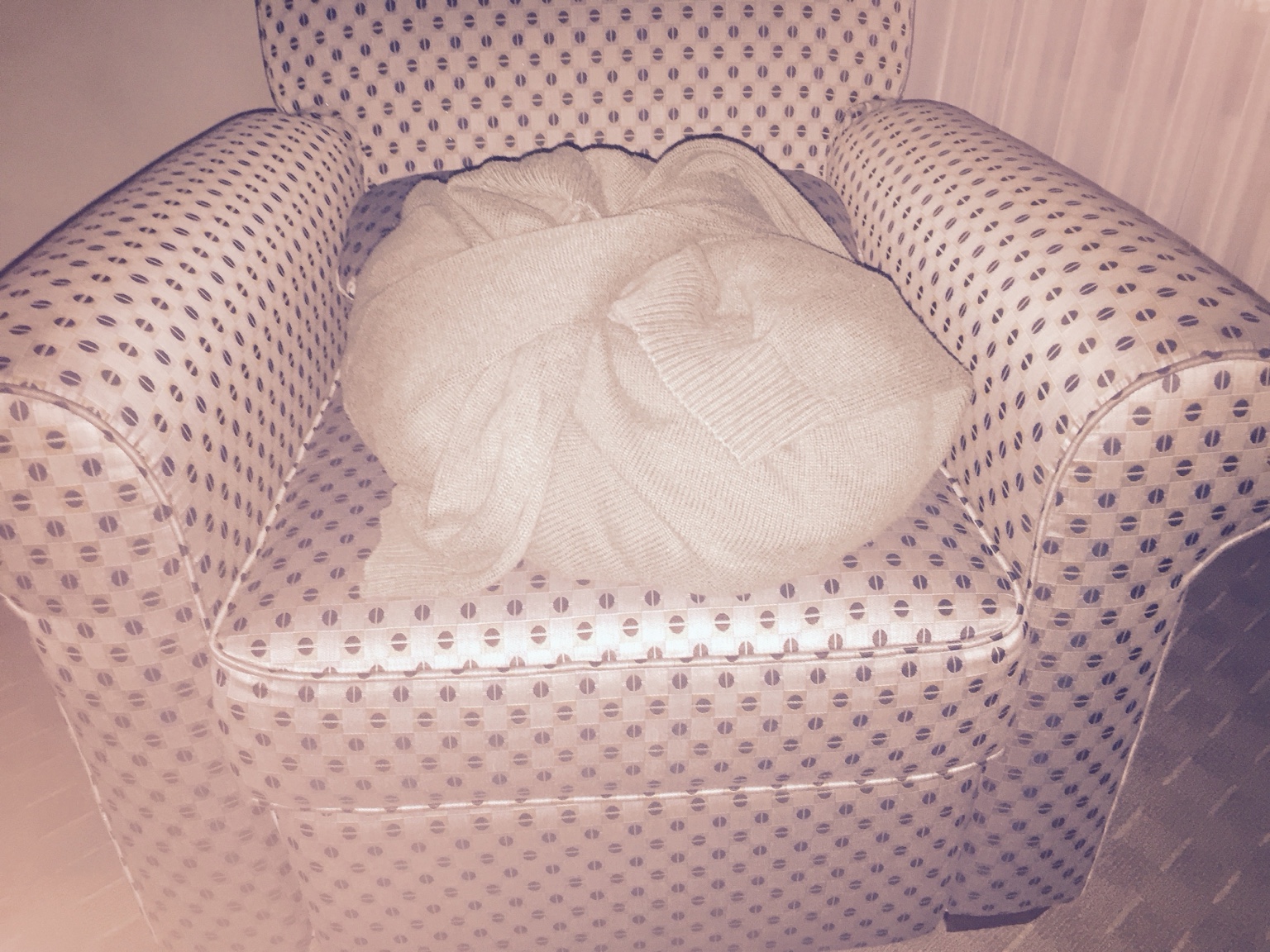
By the last show, Mike had become part of the family. We brought him onstage, made him an honorary Four Day Weekend cast member, and put him in a scene with us. I think he got some laughs, although I honestly don't remember the scene itself very well. That's improv for you.
At the end of the tour we didn't even bring our replacement keyboard home. We left it with Mike. My original equipment made it back to Texas, Mike got a keyboard, and I got a photograph of a sweater that still makes me laugh.
Jingle Bells at a funeral
My stepfather, a Methodist minister, once called needing a pianist for a funeral in a couple of hours. I didn't know the gentleman who'd died or his family. I agreed to play the hymns and some quiet music before and after.
During the service, I heard the story of a man who loved to prank people. He'd taken the little speaker from a necktie that played “Jingle Bells” when you pressed a button. He kept the button in his pocket, pressed it at wildly inappropriate times, and insisted he couldn't hear a thing.
I knew I had to play “Jingle Bells.” But when?
After the service, when his wife came forward to say her final goodbye, I gently transitioned from the soft music I was playing into a tender version of that familiar tune.
She laughed. She sobbed. She knew exactly what it meant.
That moment stays with me more than any applause. I used everything I knew about music, composition, performance, and comedic timing to help a stranger feel close to someone she'd just lost.
Trumpet riffs, wedding surprises, and emergency music
I sometimes wonder whether there is some cosmic force determined to make sure I never get entirely comfortable before a performance. At one corporate event, the power went out in the middle of the show. No keyboard. No working microphones. So I picked up my trumpet and started playing little jazz riffs between scenes. The Four Day Weekend guys moved out into the crowd and performed bits among the audience, where they could be heard. We finished the show that way.
Weddings have provided their own collection of musical emergencies. Once a bride was an hour late, so I simply had to keep playing. Another ceremony had an outdoor piano that was spectacularly out of tune. At one wedding, I discovered only when I arrived that the groom was in prison; the ceremony was being filmed for him, and I heard he would say his vows later. I still have no idea what the legal logistics of that arrangement were.
I've played a wedding involving an international matchmaking arrangement that left me with more questions than answers. And I once played for an older couple who wanted to dance down the aisle to “Fly Me to the Moon.” Honestly, I loved that one.
Then there was the bride who wanted to Rickroll her own processional. I started with the stately “Trumpet Voluntary,” then, right in the middle, switched to “Never Gonna Give You Up.” The younger guests understood instantly and started laughing. I can only imagine what some of the older guests thought was happening.
I've learned that the most useful skill at a live event is not having every note under your fingers. It's knowing what to do when the planned notes are suddenly useless.
From the improv stage to the scoring stage
For years I had been making music for stories that unfolded right in front of me. An actor would change direction, somebody would deliver a line nobody expected, and I would have to find the music in that instant. I loved it. But another part of me wanted to explore what music could do for a story unfolding on screen.
During the pandemic I started studying film scoring online. A few masterclasses grew into something much bigger. In 2022, after long conversations about the cost and commitment, I began an intensive film-scoring program through Berklee. I poured four or five hours a day, six days a week, into learning another way of telling stories. In 2023 I traveled to North Macedonia and recorded two original orchestral compositions with the FAMES Studio Orchestra.
That experience brought back the feeling of standing in front of Mr. G’s orchestra as a teenager: musicians breathing together, taking notes from a page, and turning something I had imagined into sound. Only now the players were professionals, and I had a lifetime of musical adventures behind me.
Since then I've composed for films, documentaries, and television. I scored Matter of Time, and my music for the documentary The Stones Are Speaking received a Best Music award at the Archaeology Channel International Film Festival. Each project asks for something different. The real work is listening for what the story needs, then writing music that helps the audience feel it.
In some ways, film scoring is the opposite of improv: I can return to a moment, rethink it, and shape it until every detail feels right. In another way, it's exactly the same. I am still paying attention to the people, the emotion, and the unexpected turn. I still want music to make someone laugh, cry, remember, or feel a little less alone.
I've spent most of my life sitting at a piano, waiting to see what happens next. Sometimes there's a script. Sometimes there's an orchestra. Sometimes there are forty thousand people waiting for someone to play the first note.
And sometimes there's just a friend standing beside a piano, asking a stranger a question.
“Can my friend Ray play?”
Five little words.
And I'm still answering them.
There are more stories to tell.
I'm still composing, performing, and chasing those moments when music does something no one expected. If you have a story that needs a score, I'd love to hear it.
Let's work together